

Why We Can’t Keep Doing It This Way
You started your private practice to help people heal. Not to spend your evenings writing session notes in a haze of exhaustion. Not to panic when tax season rolls around. And definitely not to wonder how you’re going to keep going when your body, mind, and spirit feel like a hollow shell.
I get it. Because I’ve been there.
For years, I thought burnout was part of the private practice. That it was normal to feel completely depleted by the end of the day. That taking a break meant I was missing opportunities to earn. That working harder was the only way to feel safer financially.
But what if you could grow a business that gives you the lifestyle you want to live?
What if instead of draining you, it could be the very thing that lets you own your wellness—physically, emotionally, mentally, financially, and spiritually?
This isn’t just a feel-good idea. It’s the foundation of a truly profitable, sustainable wellness practice. And it’s what I help wellness practitioners build every day.
Let me show you how.
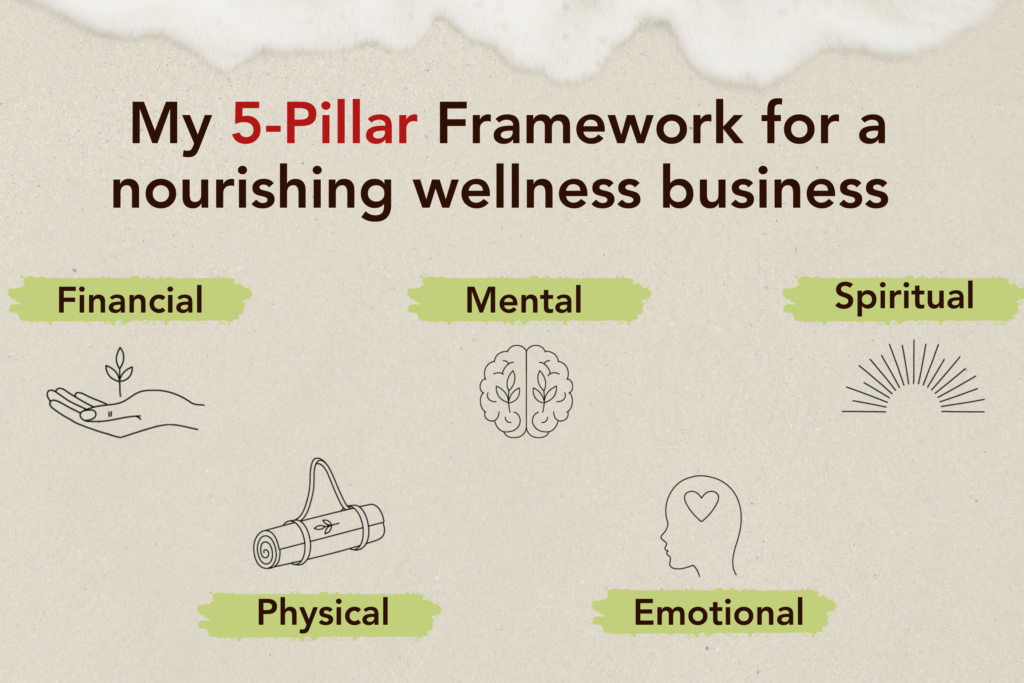
The Five Pillars That Changed My Business
This framework was born from necessity, not a business book.
It came from a bad habit of putting my clients before me in key ways:
- Answering client texts first thing in the morning, before coffee!
- Not allowing time before & after work to be solely my own.
- Waiving my cancellation policy out of concern I wouldn’t seem “nice”.
- Saying ‘yes’ because I thought ’no’ could mean clients might not come back.
- Overstacking my schedule because I thought I was saying “yes” to abundance.
It came from a turning point: when I realized that helping others shouldn’t require self-sacrifice.
That’s when I started building a private practice rooted in my wellness first.
Not just in theory, but in the actual way I structured my time, priced my services, and made decisions.
Over time, I realized there were five, essential pillars I kept coming back to.
The Five Pillars of a Thriving Private Practice
1. Financial Wellness: More Than Just Bookkeeping
This isn’t just about taxes or spreadsheets. It’s about feeling safe. Supported. Prosperous.
For me, it meant shifting from charging what I thought people could afford to charging what reflected the value of my work. I remember one client saying, “You’re undercharging for this.” It landed with a smack. The person who needed to believe in the value of my work the most was me.
So I raised my prices. But more importantly, I raised my standards. I stopped waiting for permission to be fully resourced. I stopped treating money like a toxic parent I could never please: always having to work harder, show up better, be more perfect, more available (or else!).
I shifted my perspective and treated it like a practice, just like moving my body or journaling.
“I stopped waiting for permission to be fully resourced.”
I set monthly income targets based on what I needed to feel safe and supported, not on some industry average. I built a simple structure that enabled me to track my income and expenses—which, by the way, is way more liberating and sexier than it sounds. Why is that? Because it revealed two things:
- I made more than I realized.
- I spent more than I realized, and in ways that didn’t serve my goals.
Seeing my financial landscape empowered me with the knowledge to make better budgetary decisions, which created more flow, emboldened my confidence and naturally amplified my earning potential.
And I did the mindset work to go with it. I started noticing the stories I carried: about being a helper, about scarcity, and not wanting to seem “selfish” or “greedy.” And I began rewriting those stories one by one.
I started to treat money like a healthy relationship.
Instead of chasing it (fear-based), it’s about understanding negative beliefs that are holding you back, rewiring those neural pathways, and working from a renewed relationship with money that aligns with prosperity.
Financial wellness isn’t about being perfect with money. It’s about building a relationship with it that supports the version of you that you are becoming.
2. Physical Wellness: Your Body is the Business
You can’t pour from an empty cup. You know this, but are you living it?
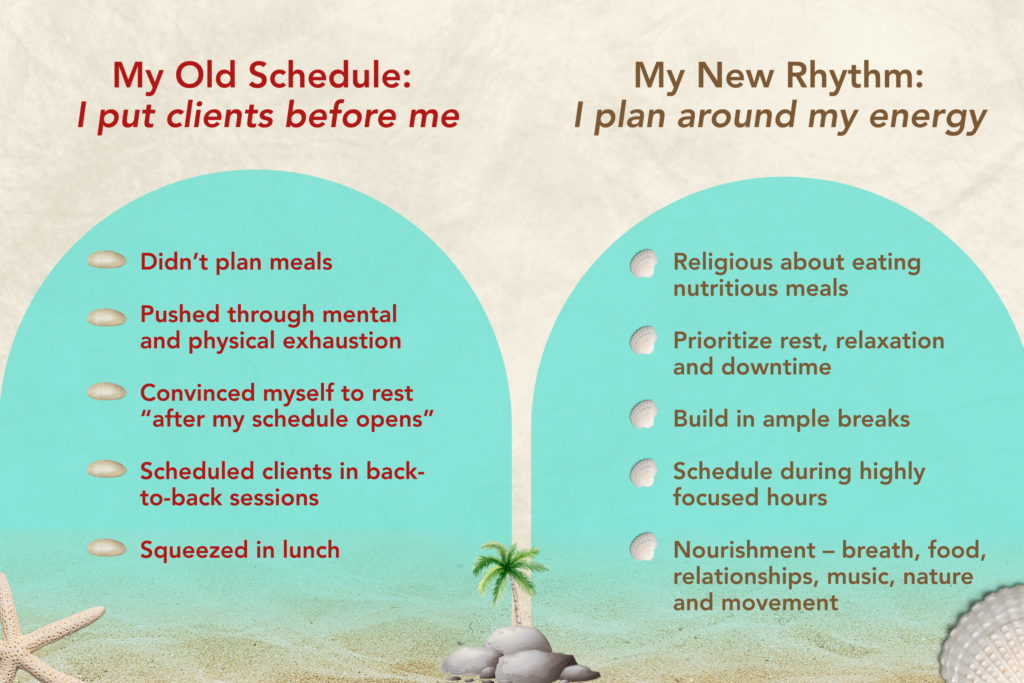
For years, I put my clients’ needs before my own body. I’d order lunch on the fly from the nearest (but not always nutritious) eatery, pushed through exhaustion, and convinced myself I could rest “once my schedule opens.”
My body was giving me clear signals: achy joints, sore muscles from crap body mechanics, and overall fatigue. But I kept overriding them.
I used to schedule clients back-to-back, squeeze lunch into the 5 minutes in between, and then feel really good about my efficiency — that “badge of busyness” so many of us wear. What I was actually doing was burning through reserves. Hard.
I finally learned to plan my schedule around my energy, not the other way around.
I think of my body as a barometer. If I feel depleted, that’s data. And I use that information to adjust my workload, reschedule non-essential stuff, and make sure I’m getting enough nourishment—not just food, but rest, movement, breathwork, enjoying my relationships and getting out into nature.
“My body is my barometer. If I feel depleted, that’s data.”
I schedule client sessions during my most grounded, focused hours and build in ample breaks to move, breathe, or simply reset. I use my higher-energy days for strategic thinking, content planning, and deeper work that supports my business windows, schedule walks between calls, and I’m religious about nutrition.
If I start over-stacking my schedule again, I see it as a sign that something in the system is off, and I step back to reframe.
This didn’t happen overnight. It took months of trial and error to find a rhythm that worked for my body and business. But once I did, a lot of things got easier. I found more joy in marketing (which is not my fave). It was easier to bring more presence in my client sessions. And I noticed creativity flowed “faster” because I was no longer running on fumes.
Meal prep, rest, and movement are my non-negotiables now. They’re not “nice to have.” They’re a business strategy. Because your body is the business.
3. Mental Wellness: Boundaries Aren’t Just for Clients

I used to believe being “flexible” made me a better practitioner.
Letting a client reschedule last minute, squeezing in one more session at the end of the day, waiving my cancellation policy. All these things felt generous. But over time, they chipped away at my clarity, my energy, and my sense of personal freedom.
What it really did was leave me burned out, disorganized, and at times resentful.
Things changed when I implemented strong policies, clear communication systems, and regular personal priority time.
I kept a running list of premium clients with flexible schedules who could easily fill slots in the event of a reschedule or cancellation. I gave myself breathing room between sessions. I created a single, go-to place for everything client-facing so I didn’t have to mentally track loose ends.
I also set boundaries with myself, not just clients. I stopped opening my calendar to anyone at any time. I designated days for client sessions, designated hours for admin work, and days that were just mine.
That structure helped me show up more fully because I wasn’t trying to do everything, everywhere, all at once.
Boundaries gave me back my peace of mind. I had the space to think strategically, rest intentionally, and create from a place of calm.
“Boundaries gave me back my peace of mind.”
And the ripple effect was that clients respected my time more. I felt more connected to my work and my work deepened.
My private practice felt sturdier.
Mental clarity is a gift you give yourself and your clients. If you’re not sure where to start with boundaries in your private practice, grab my free resource: The Essential Cancellation Policy Handbook.
4. Emotional Wellness: Staying Grounded When Things Get Hard
Let’s be honest: client work can be emotionally intense.
Holding space for someone’s grief, fear, or trauma takes more than professional training. It takes presence. And if you’re not careful, it can knock you off center, especially when you’re doing it all day, several days a week.
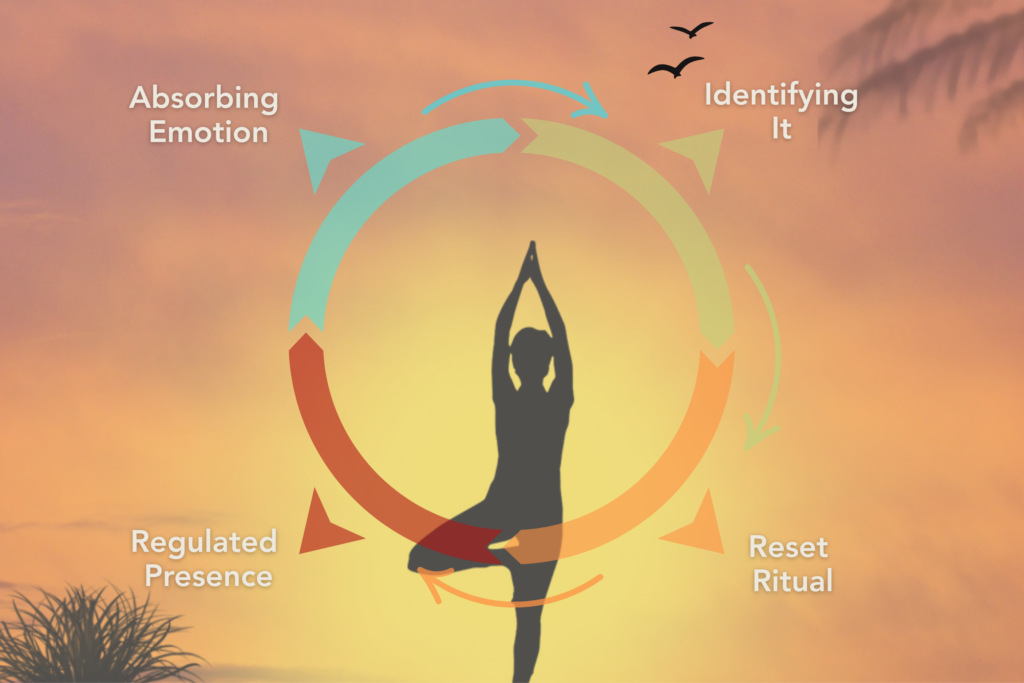
I had to learn how to process my own emotions without taking on my clients’ emotions. To be present without absorbing pain. To walk away from a tough session and come back to myself.
Early in my career, I noticed that if one client’s story lingered with me long after the session ended, it wasn’t just empathy, it was more like enmeshment. It can be subtle, even sneaky. And over time, taking on a client’s emotional energy left me feeling sucked dry and a lot less enthusiastic about my private practice.
So I started building rituals to return to myself.
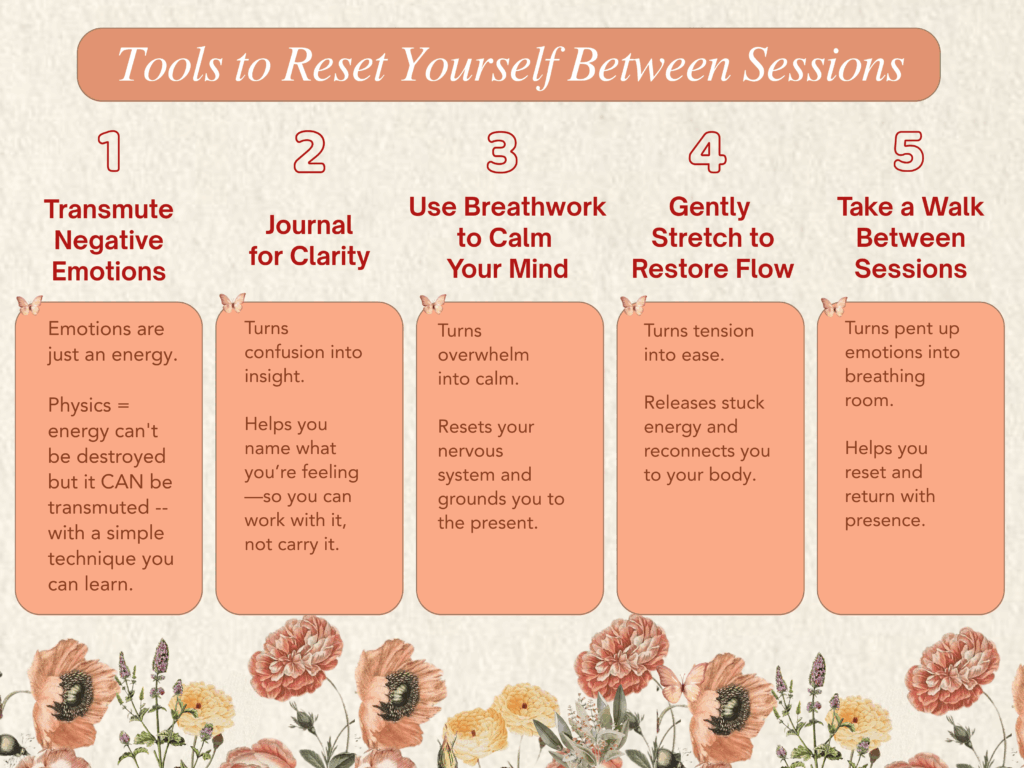
From a beloved teacher, Weston Bailey, I learned to use a powerful, transformative technique to transmute negative emotional energy.
When I combine that with breathwork, stretching, or even a walk between sessions, it’s a powerful way to stay grounded and centered within myself. In some cases, journaling can help identify what I’m holding so I can consciously apply the tools to let it go.
I’ve also learned that emotional regulation isn’t just a skill, it’s really a responsibility. If I’m dysregulated, my clients feel that. If I’m centered, they also have more room to breathe.
These tiny practices keep me regulated. Present. Compassionate. They make the work feel sustainable. Even when things get a little heavy.
Calming ritual list:
5. Spiritual Wellness: The Root of it All
This is the piece a lot of us skip.
And I’ve found it to be the most sustaining. When life feels hard, or marketing feels slow, if a client ghosts, or when you’re questioning your next step, this is the part that reminds you why you started in the first place.
If you don’t stay connected to why you do this work, you’ll end up resenting it. Or losing your way. Or both.
That’s why spiritual wellness is non-negotiable in my framework.
For me, it’s a mix of visualization, meditation, and tuning into myself. I make space to check in: how am I feeling about my day today? What do I need to be fully present? Am I holding onto any BS that can be released?
If my day contains a client who’s a little more challenging to work with, maybe their energy is frenzied, or they tend to talk “at you,” not with you (as in: you could walk away and they’d keep talking), I first identify what comes up for me could be (tension, or resentment, or feeling drained).
Next, I take a moment to transmute and release it. Then I consciously shift to view them through the lens of compassion.
This simple, powerful exercise heightens my ability to be present and releases attachment without suppressing my emotions.
It frees up space to allow them to be who they are, without any wish for them to be “easier,” while helping me steer clear from taking on their energy dump.
That’s how I made one of my biggest pivots. When I was fully booked but something still felt off, I kept feeling this nudge. When I finally slowed down and listened, I realized I needed to restructure how supported clients so that it felt more sustainable for both of us.
Spiritual wellness helps me discern which opportunities align and which ones don’t. It gives me the courage to pivot. It brings me back when I start to drift.
And it reminds me that I’m not here to serve everyone. I’m here to serve the right ones.
“I’m not here to serve everyone. I’m here to serve the right ones.”
Where to begin to build your own private practice
You don’t have to overhaul everything tomorrow. In fact, please don’t.
I tell my clients all the time: awareness is step one. You can’t build something sustainable if you don’t first understand what’s draining you.
Start by asking: which pillar feels most depleted right now? Where do you feel the most friction? Where are you white-knuckling your way through the week?
Pick one.
Schedule a 15-minute personal priority appointment with yourself to reflect. Actually block it out on your calendar, don’t leave it as a maybe. (I see you. 😁)
Then take one small step this week to strengthen that pillar.
Maybe it’s moving your pricing page above the fold because your dream clients keep DMing instead of booking.
Maybe it’s blocking out an hour for a real lunch break because you’ve realized your crusty old granola bars ain’t cutting it anymore.
Maybe it’s rewriting your cancellation policy after resenting yet another late cancellation you didn’t charge for.
This is how you start to shift things. Not all at once. And not perfectly.
Just an honest checking in with yourself. An intentional change. Then another. And another.
This is how we rebuild, holistically, by treating the cause, not the symptom. This is how your practice starts to respect your energy, your time and your life.
Come Back to Center Without Burnout
Burnout isn’t inevitable. But it is the result of building a private practice that takes more than it gives; it’s a way of saying “yes” to everything but your own well-being, over and again.
When you root your practice in these five holistic pillars, you feel more whole. You begin to feel the balance we’re all looking for.
Your clients feel the difference. Your bank account feels the difference. And perhaps most importantly, you start feeling proud of how you’re showing up again in your work and your life.
You stop questioning if you’re cut out for this, or swinging between “I love this work” and “I don’t know how much longer I can do this.”
Instead, you build a business suits the life you want to live. A private practice that grows with you, not at your expense.
That kind of transformation doesn’t require a perfect plan. It just requires a pause. A pattern interrupt. And a willingness to do it differently this time.
If you’re not sure where to begin, my free guide — Essential Cancellation Policy Handbook, is a great first step. You’ll learn how to communicate policies clearly, enforce them confidently, and protect your time without guilt.
And if you’re ready for more personalized support, I’d be honored to walk with you. You can apply to work with me 1:1 or explore upcoming offers at https://katfleming.com/coaching-courses.
Let’s build that version of your private practice, the one that supports you just as much as you support everyone else.